PATENT专利 · CNIPA · 发明专利证书

A Method for Independently Detecting Upper and Lower Finger Edges in Low-Quality Finger Vein Images 一种用于低质量指静脉图像的手指上下边缘独立检测方法

Y. Hu1 M. A. Amin1 D. Wen1 Y. Wang1 F. Liu1
1School of Electronics and Information Engineering, South China University of Technology, Guangzhou, P.R. China华南理工大学电子与信息工程学院,中国广州
№ P1

ABSTRACT摘要

What is the problem and what did we invent? 我们解决了什么问题

Finger vein recognition is a highly secure and reliable biometric technology due to its internal physiological characteristics. However, in practical acquisition scenarios, low-quality finger vein images frequently arise from factors such as uneven illumination, finger displacement, and skin condition variations. Accurate finger edge detection is a critical preprocessing step for region-of-interest (ROI) extraction, yet conventional edge detection methods struggle with low-contrast boundaries in degraded images. 指静脉识别因其内在的生理特征而成为一种高度安全可靠的生物特征识别技术。然而,在实际采集场景中,由于光照不均、手指位移和皮肤状况变化等因素,低质量指静脉图像频繁出现。准确的手指边缘检测是感兴趣区域(ROI)提取的关键预处理步骤,但传统的边缘检测方法在处理退化图像中的低对比度边界时面临困难。

This invention proposes a method for independently detecting the upper and lower edges of fingers in low-quality finger vein images. By decoupling the edge detection process for the top and bottom boundaries, the method adapts to asymmetric degradation patterns commonly observed in finger vein imaging. The approach robustly locates finger contours even under challenging conditions, enabling accurate ROI extraction for subsequent recognition tasks. 本发明提出了一种用于低质量指静脉图像的手指上下边缘独立检测方法。通过将上下边界的边缘检测过程解耦,该方法能够适应指静脉成像中常见的非对称退化模式。即使在具有挑战性的条件下,该方法也能稳健地定位手指轮廓,为后续识别任务实现准确的ROI提取。

The proposed method addresses the limitations of global edge detection strategies by employing independent processing paths for upper and lower edges, accommodating the distinct intensity profiles and noise characteristics of each boundary. This independent detection framework significantly improves edge localization accuracy in low-quality images compared to conventional unified detection approaches. 所提出的方法通过为上下边缘采用独立的处理路径来解决全局边缘检测策略的局限性,适应每个边界不同的强度分布和噪声特征。与常规统一检测方法相比,这种独立检测框架显著提高了低质量图像中的边缘定位精度。

№ P2

PATENT CERTIFICATE专利证书

Officially granted by the China National Intellectual Property Administration. 由国家知识产权局正式授权

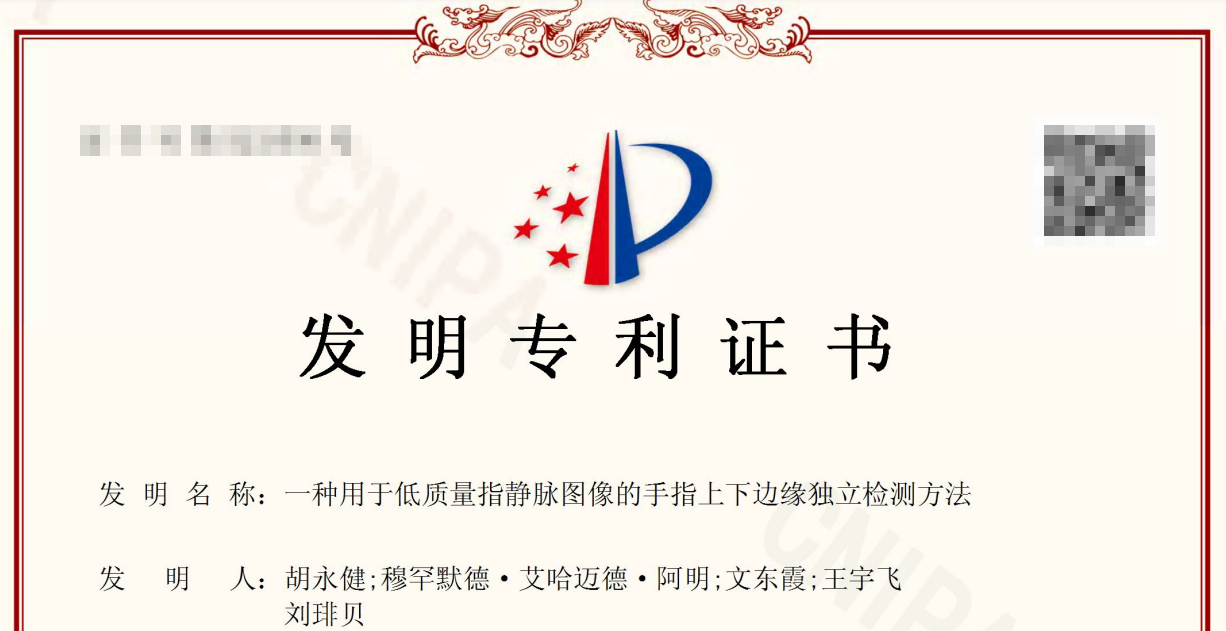
Fig. 1 — Chinese Invention Patent Certificate Fig. 1 — Chinese Invention Patent Certificate (发明专利证书) issued by CNIPA. Invention title: 一种用于低质量指静脉图像的手指上下边缘独立检测方法. Inventors: 胡永健; 穆罕默德·艾哈迈德·阿明; 文东霞; 王宇飞; 刘琲贝. 图1 — 国家知识产权局颁发的中国发明专利证书。发明名称:一种用于低质量指静脉图像的手指上下边缘独立检测方法。发明人:胡永健;穆罕默德·艾哈迈德·阿明;文东霞;王宇飞;刘琲贝。
№ P3

METHOD方法

Independent upper and lower edge detection. 上下边缘独立检测

01

Image Preprocessing and Enhancement图像预处理与增强

The acquired finger vein image undergoes preprocessing to normalize illumination and reduce noise. Adaptive contrast enhancement is applied to compensate for uneven lighting conditions, preparing the image for robust edge detection. 采集到的指静脉图像经过预处理以归一化光照并降低噪声。应用自适应对比度增强来补偿不均匀的光照条件,为稳健的边�ite检测准备图像。

02

Upper Edge Independent Detection上边缘独立检测

The upper finger edge is detected through an independent processing path that analyzes the intensity gradient profile along the vertical direction. The method accounts for the specific characteristics of the upper boundary, including typical illumination falloff and skin texture patterns. 上边缘通过独立处理路径进行检测,该路径分析垂直方向上的强度梯度分布。该方法考虑了上边界的特定特征,包括典型的光照衰减和皮肤纹理模式。

03

Lower Edge Independent Detection下边缘独立检测

Similarly, the lower finger edge is detected through a separate independent path optimized for the lower boundary's distinct intensity profile. This decoupled approach allows the method to handle asymmetric degradation where upper and lower edges exhibit different quality characteristics. 类似地,下边缘通过针对下边界不同强度分布优化的独立路径进行检测。这种解耦方法允许该方法处理上下边缘表现出不同质量特征的非对称退化情况。

04

ROI Extraction and RefinementROI提取与细化

The independently detected upper and lower edges are combined to define the finger region. The region of interest is extracted and refined for subsequent vein pattern recognition, ensuring accurate localization despite low image quality. 独立检测到的上下边缘被组合以定义手指区域。提取并细化感兴趣区域用于后续的静脉模式识别,确保即使在低图像质量下也能准确定位。

№ P4

ADVANTAGES优势

Key benefits of the proposed invention. 所提发明的关键优势

Robustness to Low-Quality Images对低质量图像的鲁棒性

By independently processing upper and lower edges, the method adapts to asymmetric degradation patterns that commonly occur in finger vein imaging. This independent detection strategy significantly outperforms unified approaches when one edge is substantially more degraded than the other. 通过独立处理上下边缘,该方法能够适应指静脉成像中常见的非对称退化模式。当一条边缘比另一条退化严重时,这种独立检测策略显著优于统一处理方法。

Improved Edge Localization Accuracy提高边缘定位精度

The decoupled edge detection framework allows each boundary to be processed with parameters and thresholds optimized for its specific characteristics. This customization leads to more precise edge localization, directly improving the quality of ROI extraction. 解耦的边缘检测框架允许每个边界使用针对其特定特征优化的参数和阈值进行处理。这种定制化带来了更精确的边缘定位,直接提高了ROI提取的质量。

Enhanced Recognition Performance增强识别性能

Accurate edge detection and ROI extraction are foundational to reliable finger vein recognition. The proposed method's robust preprocessing ensures that subsequent feature extraction and matching stages operate on high-quality region data, improving overall system accuracy. 准确的边缘检测和ROI提取是可靠指静脉识别的基础。所提方法的稳健预处理确保后续特征提取和匹配阶段在高质量区域数据上运行,提高整体系统准确率。

№ P5

SCOPE & APPLICATIONS范围与应用

Where this invention applies. 发明的应用领域。

Biometric security systems. The invention is directly applicable to finger vein recognition systems deployed in access control, financial authentication, and personal device security where imaging conditions may vary. 生物特征安全系统。本发明可直接应用于部署在门禁控制、金融认证和个人设备安全中的指静脉识别系统,这些场景中的成像条件可能各不相同。

Medical imaging preprocessing. The independent edge detection approach can be extended to other medical imaging modalities where anatomical boundaries need robust localization under varying quality conditions. 医学图像预处理。独立边缘检测方法可扩展到其他医学成像模态,这些模态需要在不同质量条件下对解剖边界进行稳健定位。

Embedded and mobile platforms. The method's efficient processing pipeline makes it suitable for implementation on resource-constrained embedded systems and mobile biometric devices. 嵌入式和移动平台。该方法高效的处理流程使其适合在资源受限的嵌入式系统和移动生物特征设备上实现。

№ P6

PATENT INFO专利信息

Cite this patent. 引用此专利

@patent{hu2020finger,
  author    = {Hu, Yongjian and Amin, Muhammad Ahmad and Wen, Dongxia and Wang, Yufei and Liu, Feibei},
  title     = {一种用于低质量指静脉图像的手指上下边缘独立检测方法},
  title_en  = {A Method for Independently Detecting Upper and Lower Finger Edges in Low-Quality Finger Vein Images},
  type      = {Chinese Invention Patent},
  country   = {China},
  assignee  = {South China University of Technology},
  year      = {2020},
  number    = {ZL 2018 1 XXXXXXX.X}
}